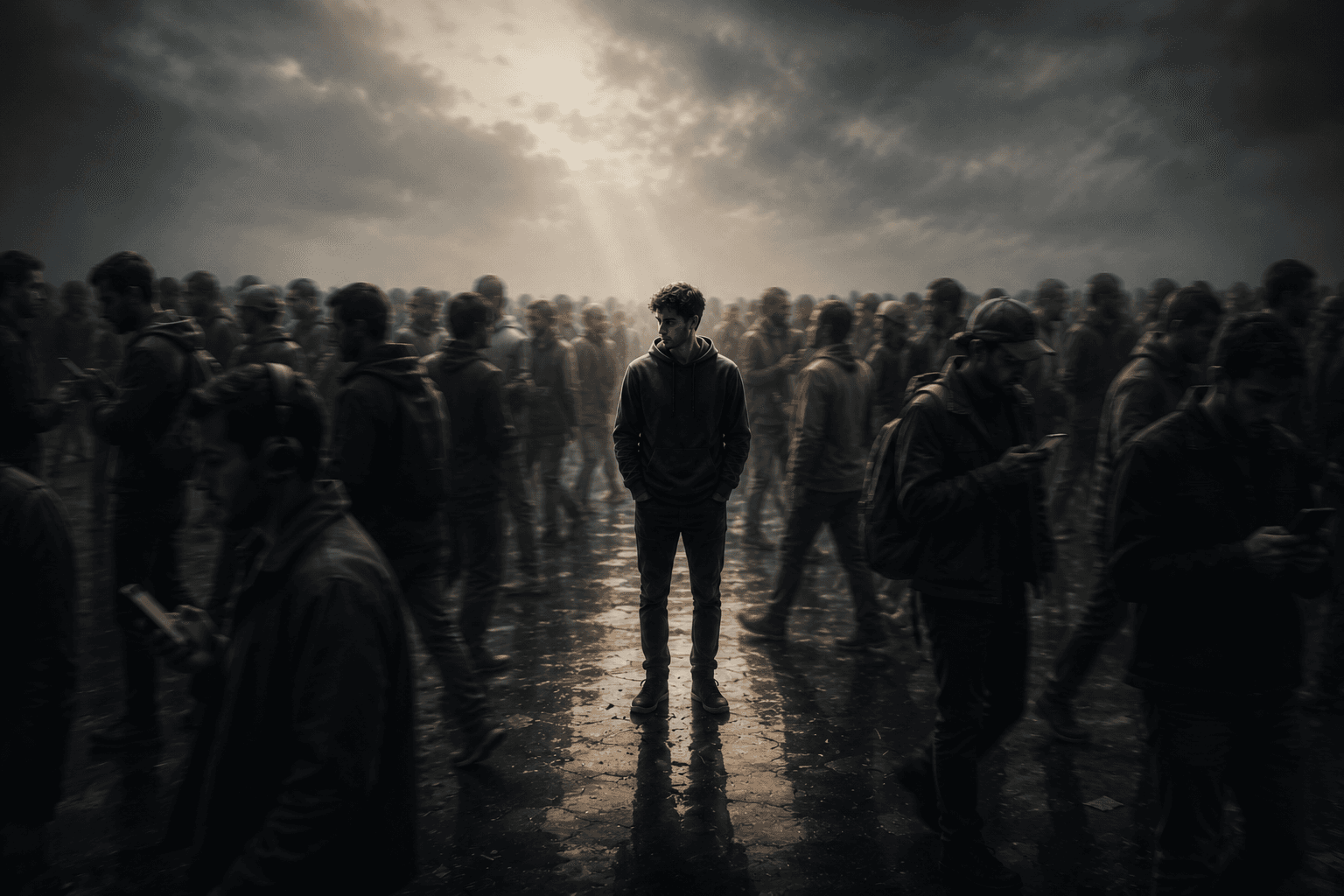
The Paradox of the Crowd
Imagine standing in the middle of a crowd. Thousands of bodies in motion. Thousands of voices merging into a single roar. And yet — you are still. Not because you cannot move. But because you see.
This image is not a literary device. It is the inner reality of those who have begun to look at the world with open eyes. Consciousness is not a capacity you either have or don't. It is a state that unfolds within us — slowly, sometimes painfully.
What Does It Mean to Be Conscious?
The word "consciousness" is harder to grasp than it appears. In philosophy, it describes the awareness of one's own thinking — the "I know that I know." In psychology, it refers to the ability to recognise one's own patterns, to step back from automatism.
But in a social sense, consciousness means something more fundamental: knowing your position in the world. Understanding how the structures we inhabit shape us — and how we might shape them in return.
The Solitude of the Awake
Those who begin to live consciously often discover: it is lonely. Not because they have distanced themselves from others. But because they see things others do not yet see. Injustices. Contradictions. The quiet violence of what is considered normal.
This solitude is not a sign of failure. It is a sign of maturity. The person in the image — still, watching, surrounded by movement — is not an outsider. They are a witness. And witnesses have an indispensable function in every society.
Consciousness as a Collective Task
In the end, individual consciousness is only the beginning. A society that understands itself — that knows its history, bears its contradictions, and wants to shape its future — does not need a handful of the awakened. It needs a culture of consciousness.
This is not a utopian wish. It is a practical necessity. Because a crowd that does not think is not a collective. It is a mass. And masses are led — not by ideas, but by fears.
